The dog wouldn’t look at him.
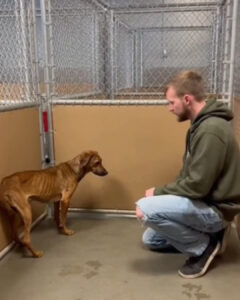
It sat pressed against the back wall of the kennel, ribs sharp beneath thin fur, paws tucked tight under its body as if trying to make itself smaller. One ear was torn. The other twitched at every sound. Its eyes were fixed on the concrete wall, not out of defiance, but habit — the learned posture of an animal that had discovered long ago that meeting a human’s gaze rarely ended well.
Sam noticed all of it the moment he stopped in front of the kennel.
He had volunteered at the shelter for years, long enough to recognize the difference between fear and resignation. This wasn’t a dog waiting to be rescued. This was a dog that had already decided not to hope.
The tag on the gate was simple.
Male.
Approx. 3 years.
Stray.
“Does not do well with people.”
Sam crouched anyway.
The concrete floor was cold through his jeans as he lowered himself slowly, deliberately, making sure his movements were small, predictable. He didn’t reach for the latch. He didn’t speak at first. He just sat there, at eye level, a few feet away.
After a moment, he spoke softly.
“Hey, buddy,” he said. “You don’t have to come over.”
The dog flinched.
Not dramatically — just enough to reveal how tightly coiled its nerves still were. Its body went rigid, breath shallow, as if bracing for impact.
Sam felt something tighten in his chest.
“I know,” he added quickly, voice barely above a whisper. “I won’t touch you.”
He shifted his hands to his knees, palms open, visible.
“I’ll just sit here,” he said. “That’s all.”
Then he went quiet.
Minutes passed.
The shelter was alive with sound — the distant clang of metal bowls, the echo of barking down the corridor, the muffled voices of staff and visitors — but inside the kennel, time stretched thin. Sam didn’t move. He didn’t check his watch. He didn’t glance at his phone.
He breathed.
The dog watched him from the corner of its eye, barely turning its head. Years of instinct scanned Sam for danger: sudden movements, reaching hands, raised voices. None came.
Another minute passed.
Then another.
Sam felt his legs begin to ache, but he welcomed the discomfort. It reminded him to stay present. To stay still.
The dog shifted.
Just slightly at first — a paw sliding forward an inch, claws scraping softly against concrete. Then it froze again, heart pounding, waiting for the punishment that usually followed courage.
Nothing happened.
Sam remained exactly where he was.
The dog took another step.
And another.
Each movement was careful, rehearsed, as if it had learned long ago that progress came at a cost. Its ribs rose and fell rapidly. One ear flattened. The other tilted forward, curious despite itself.
Sam kept his gaze lowered, not wanting to challenge or overwhelm.
When the dog finally reached him, it didn’t jump or wag its tail. It didn’t lick his hand or climb into his lap.
It leaned its head against Sam’s knee.
Just rested it there.
The weight was light — far too light for a dog its size — but the gesture carried the gravity of a confession.
The dog let out a long, shaky breath.
Sam swallowed hard.
“Yeah,” he whispered. “I know.”
He knew that breath. He had heard it before — from animals that had been tied up too long, from dogs that had learned the rhythm of fists and boots, from creatures that had survived by disappearing emotionally long before they were ever physically rescued.
He rested his hand lightly on the dog’s back, barely making contact, just enough for warmth to pass between them.
“You’re safe now,” he said quietly.
The dog didn’t pull away.
That was when Sam noticed the scars.
Old ones, mostly. Faded lines across the flank. A patch of fur missing on the shoulder. A healed fracture that had never quite set right, leaving the dog with a subtle limp when it moved.
Sam didn’t ask questions he already knew the answers to.
Instead, he stayed.
He stayed through the next breath. And the one after that. He stayed while the dog adjusted its weight, testing whether the hand on its back would turn into a grip. He stayed when the dog flinched at a sudden bark from down the hall.
“It’s okay,” Sam murmured. “That’s not for you.”
The dog pressed a little closer.
For the first time since arriving at the shelter weeks earlier, it closed its eyes.
Just for a second.
Sam felt tears prick at the corners of his own.
He had come to the shelter that day expecting to walk dogs, clean kennels, refill water bowls — the quiet, necessary tasks that kept the place running. He hadn’t expected this. He hadn’t expected the weight of a stranger’s trust to settle so suddenly against his knee.
But that was how it always happened.
Healing never announced itself.
It arrived quietly, in moments like this — when no one was watching, when there were no cameras or applause, when the only witnesses were two beings learning, tentatively, that the world might not hurt them every time.
A volunteer passed by the kennel and paused, surprised.
Sam lifted a finger gently to his lips.
The volunteer nodded and moved on.
Another few minutes passed. The dog’s breathing slowed. Its body, once rigid as wire, softened inch by inch. It didn’t move away. It didn’t ask for more. It simply existed — leaning, breathing, resting.
Sam knew better than to rush it.
Some wounds didn’t close because someone wanted them to. They closed when the body decided it was safe enough to try.
Eventually, the dog shifted again, lifting its head slightly to look at Sam’s face.
Their eyes met.
The dog didn’t flinch this time.
Sam smiled, small and careful.
“Hey,” he said again. “There you are.”
The dog blinked.
No tail wag. No sudden transformation into joy.
Just a quiet acknowledgment: I see you.
Sam stayed with him until his legs went numb, until the shelter lights dimmed and the evening shift began. When it was finally time to leave, he didn’t stand up abruptly. He didn’t pull his hand away.
“I’ll be back tomorrow,” he said softly. “Same time.”
The dog watched him go, eyes following for the first time.
That night, when Sam filled out the paperwork, he didn’t hesitate.
Foster application.
Immediate.
The staff exchanged knowing looks.
“He doesn’t do well with people,” one of them said gently.
Sam nodded. “I know.”
“He hasn’t let anyone touch him.”
Sam smiled. “He let me sit.”
Two days later, the kennel was empty.
Not because the dog had been adopted immediately. Not because he had suddenly become friendly or easy or “fixed.”
But because someone had chosen to meet him where he was.
On the drive home, the dog curled tightly in the back seat, still wary, still quiet. When the car stopped at a red light, Sam glanced in the mirror.
The dog’s eyes met his.
And this time, when Sam smiled, the dog’s tail moved — just once.
That was enough.
Because sometimes, rescue doesn’t look like saving.
Sometimes, it looks like sitting on a cold concrete floor, saying nothing at all, and waiting long enough for trust to take its first, trembling step forward.