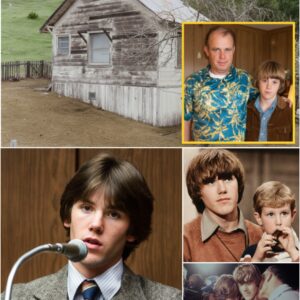
It is 8:47 on the morning of August 2, 1993.
Derrick Robie stands at the front door of his house on Garfield Street in Savona, New York — a town so small that most people outside of Steuben County have never heard of it. He is four years old. He is wearing sneakers that are slightly too big for his feet, the way kids’ shoes always seem to be when their mothers buy them a size ahead. He has a lunch bag in his hand — packed by his mother, Doreen, who put in a banana, a small container of food, and a juice pouch of red Kool-Aid.
His baby brother, Dalton, is crying somewhere in the house. Doreen is busy. Derrick sees his chance.
“It’s OK, Mom,” he says. “I’ll go by myself. You know, it’s no problem. The kids are probably going down the street.”
Doreen looks at her boy. The park is one block away. Same side of the street. No roads to cross. Dead-end block. She has walked this route with him a hundred times. She knows every crack in the sidewalk.
She packs his lunch. She kisses him.
“I love you,” she says.
“I love you, Mom,” Derrick says.
And he goes hopping off the sidewalk.
Doreen would spend the rest of her life hearing those four words. Not with warmth — with the specific, searing quality of something that cannot be taken back, something said at exactly the wrong moment to be the last thing ever said.
By noon, storm clouds were rolling in over the hills.
Doreen had an awful feeling.
She raced to the park.
Derrick had never arrived.
The Town That Thought It Knew Its Children

Savona, New York sits in the southwestern part of Steuben County, tucked between rolling hills and quiet farmland in a part of the state that most New Yorkers couldn’t find on a map without looking. It is the kind of place where people leave their doors unlocked, where everybody waves at everybody, where children walk to the park without their parents because everyone within a two-mile radius knows everyone else’s name and face.
In the summer of 1993, Savona had a population of just a few hundred people. The kind of population where a four-year-old boy could become something of a local celebrity not through any remarkable achievement but simply through the sheer force of his own irresistible personality.
Derrick Joseph Robie was born on October 2, 1988, the firstborn son of Dale and Doreen Robie. From the very beginning, he operated as though he had been placed on earth to make other people smile. He played T-ball with a ferocity and enthusiasm that made his father, Dale — who coached the team — occasionally have to stop himself from laughing on the field. He participated in every recreation program the town offered. He greeted passersby from the corner near his house with the gravity and ceremony of a sitting official.
The neighbors called him the unofficial mayor of Savona.
At four years old.
“He was my cute little firecracker,” Doreen would say, years later, in a courtroom where she was not permitted to describe her son in full — a restriction that still made her furious decades later. “I wish I would have gotten a chance to talk about Derrick a little more. It really wasn’t fair that I didn’t get to tell them what kind of kid he was.”
Dale Robie coached T-ball because Derrick loved it more than anything.
“He’d go, ‘This one’s for you, Mommy,’” Doreen recalled. “And he usually did.”
That morning — August 2, 1993 — was the first time Doreen had ever let Derrick walk to the park alone. She had thought about it. The route was simple. The distance was nothing. He knew every step of the way. And his baby brother needed her.
She would spend years turning that decision over in her mind. Not with guilt — she eventually made peace with it, because she had to — but with the specific ache of understanding exactly what the last ordinary moment of her child’s life looked like, and knowing she had been standing in the doorway watching it.
The Other Boy In Savona
On the other side of town, another family was getting another boy ready for the same summer camp at the same park.
Eric M. Smith was born on January 22, 1980, in Steuben County. He had bright red hair, freckles across his face, thick glasses, and ears that stuck out in a way that, in the merciless arithmetic of childhood cruelty, made him a target from the time he started school.
The bullying had been going on for years. Not the ordinary background noise of schoolyard teasing — something more sustained and systematic than that. His classmates mocked his ears. They mocked his glasses. They mocked his red hair and his freckles and his short stature. He was held back a grade, which only compounded the isolation. He was a loner who spent hours riding his bicycle around town — alone — simply because it was the one activity that put distance between himself and the people who made his life miserable.
His mother, Tammy Smith, knew he was struggling. She had watched him come home from school with his fists clenched, watched him bang his head against the floor in frustration as a toddler, watched the anger accumulate in him over years without any good place to go.
His stepfather, Ted Smith, remembered the day Eric came to him in the kitchen, “really upset,” crunching his fists, shaking, and said: “Dad, I need help. I feel like I want to hurt somebody.”
Ted Smith heard his stepson say that. He noted it. He worried about it.
And the summer continued.
What no one in the Smith household — or anyone else in Savona — fully understood in the summer of 1993 was that Eric Smith’s internal world had been accumulating pressure for a very long time, and that pressure had found a direction. Not toward the bullies who had tormented him. Not toward himself. Toward whoever happened to be smaller and more vulnerable and in the wrong place at the wrong time.
As Eric later said himself: “I just saw this kid. This blond kid. And I wanted to hurt him.”
One Block. One Morning. One Decision.
The small patch of woods between the park and Garfield Street was not a forest. It was the kind of scraggly urban-edge tree line that exists in small American towns — a few dozen yards of overgrowth that separates a parking lot from a ball field, the kind of place where older kids sometimes sneak cigarettes and younger ones play at adventure.
On the morning of August 2, 1993, Eric Smith was riding his bicycle to the same park where Derrick Robie was walking. They were on the same route. Going to the same place.
Eric saw Derrick walking alone.
A small blond boy. Four years old. A lunch bag in his hand. Sneakers slightly too large.
Eric stopped his bike.
He told Derrick he knew a shortcut to the park. Through the trees. It would be faster.
Derrick Robie, four years and ten months old, who had never been given a reason to distrust anyone, who had been raised in a town where strangers were neighbors and neighbors were family — Derrick went with him.
They walked into the trees together.
What happened next was reconstructed through physical evidence, through Eric’s own confession, and through years of testimony that made hardened investigators go quiet when they described it.
Eric strangled Derrick until the boy lost consciousness. He then picked up a large rock from the ground — investigators described it as very large, requiring real physical effort to lift — and brought it down on Derrick’s head. Then a smaller rock. Then a stick, which he used to sodomize the child’s body. Then he opened Derrick’s lunch bag, smashed the banana against the wounds, and poured the red Kool-Aid into the places where the rocks had broken the skin.
Then he arranged the body.
Left sneaker placed near the right hand. Right sneaker placed near the left hand. As though something in Eric Smith’s mind, at 13, needed the act to have a shape — a deliberateness, a staging — that went beyond the act itself.
Lead investigator Charles Wood would later describe the scene in terms that still sound clinical even now, all these years later. Because clinical was the only language available that didn’t collapse under the weight of what he was describing.
The cause of death was determined to be blunt trauma to the head, with contributing asphyxia.
Derrick Robie was four years old and ten months. He had been walking one block to a summer camp program with a lunch his mother had packed.
The whole thing, from the moment they entered the trees to the moment Eric walked back out, took less than fifteen minutes.
“He Never Arrived”
At 11:00 a.m., Doreen Robie felt the storm coming in — felt it physically, with the specific dread of a mother who cannot explain why her chest is tight — and rushed to the park to pick up Derrick.
She was told her son had never arrived.
She remembered the moment the rain began.
“I swear that was the moment that he died,” she said, years later. “I think that he was letting me know.”
Dale Robie, when asked to describe that afternoon, could not get through it. He turned to Doreen midway through the sentence. She finished it for him. They had been doing that for thirty years.
Police were called. A search was organized. Within a few hours, in the late afternoon, searchers found what they were looking for in the small patch of woods between the park and the street.
A few yards from the ball field. A few hundred yards from the Robie front door. In a town where nobody locked their doors.
The entire community of Savona shut down that evening. Parents kept their children inside. People spoke in the lowered voices of communities that have been broken open. The immediate assumption — the one that everyone reached for because the alternative was simply too disturbing — was that a stranger had driven through Savona. Someone passing through. Someone from somewhere else. Someone no one knew.
No one who lived here could have done this. Not to Derrick. Not to the mayor of Savona.
Eric Smith’s grandfather, Red Wilson, believed the same thing. He said so plainly: “When this terrible thing was done, everybody, including myself, thought it was an adult and how could anybody do such a terrible, terrible thing.”
Eric, at that point, was sitting in his grandfather’s house with his hands in his lap, saying nothing about what he had done two miles away that morning.
The Boy Who Walked Into The Command Post
Six days after Derrick Robie’s death, Eric Smith did something that, in retrospect, reveals either staggering arrogance or a thirteen-year-old’s complete failure to understand the consequences of what he had set in motion.
He walked into the police command post — the same room where investigators were working the case — and offered to help.
Investigator John Hibsch had been running interviews for days. He had talked to everyone who might have seen anything. He was exhausted, frustrated, running out of leads. And now here was a freckle-faced kid from across town, asking if he could be useful.
Hibsch talked to him.
And Eric Smith was — there is no better word for it — enthusiastic.
“Totally enjoyed it,” Hibsch would say, years later. “Totally enjoyed it. Didn’t want it to end. He’s looking right at me. He’s kind of hunched over a little bit and he’s very, very upbeat, very happy. He likes the fact that he’s being talked to.”
Eric initially denied seeing Derrick at all. Then, without warning, he changed his story. Said he had seen Derrick across the street from an open field. Described what Derrick was wearing — accurately, including the lunch bag. And then, when Hibsch pushed him to specify exactly where he had last seen the boy, something shifted.
Eric’s voice cracked. His head went down. His fists came up and started vibrating.
“You think I killed him, don’t you?”
Hibsch noted the reaction. He asked for a break. Someone brought Eric a glass of red Kool-Aid.
Eric grabbed it and threw it on the floor.
Hibsch knew — at a gut level, in the way experienced investigators know things before they can prove them — that this boy had done it. But he couldn’t get there. There was a block. He thought, in the way that adults are trained to think, that a thirteen-year-old child must have witnessed something terrible and been threatened into silence.
Not that the thirteen-year-old child was the something terrible.
The next day, police asked Eric to take them through his route on his bicycle — a standard re-enactment protocol. Hibsch watched the boy ride through the crime scene neighborhood on camera, cool and calm, narrating his own movements with the casual familiarity of someone who had ridden this route a hundred times.
“During the re-enactment,” Wood later said, “I would have to say he enjoyed it. He was having a good time.”
And then the investigators noticed a problem with Eric’s story. He claimed to have seen Derrick from a distance that — once you stood at the spot and looked — made it physically impossible to see what he said he saw. His account required him to have been much closer to Derrick than he claimed.
His grandfather sensed it too. The family gathered around Eric and told him the truth: they knew he was hiding something. They thought he had been threatened. They thought he had witnessed the murder and someone had told him to keep quiet.
They took him to the police.
They never imagined what he would say.
“I’m Sorry, Mom. I Killed That Little Boy.”
On August 8, 1993 — six days after Derrick Robie died in the trees — the Smith family sat Eric down.
His grandfather Red Wilson was there. His mother was there.
They begged him to tell the truth. They told him he was safe. They told him whatever he had seen, whatever he knew, it was time to say it out loud.
Eric looked at his mother.
“I’m sorry, Mom. I’m sorry. I killed that little boy.”
Red Wilson would repeat those words for the rest of his life, trying to understand them, failing every time.
“It’s still hard to believe,” he said, decades later. “The question is, you know, to me, why? How? How could he take the life of a little boy?”
The family called the police that night. Eric was taken in. He confessed again, in detail, and his words were recorded in documents that investigators would read and re-read over the following months, and that a prosecutor would read aloud in a courtroom the following year, and that would continue circulating in news reports and interviews and parole hearing transcripts for thirty years.
Captain Walter Delap asked Eric directly: “Why did you do it?”
Eric said: “I don’t know. I just saw this kid. This blond kid. And I wanted to hurt him.”
The Freckle-Faced Killer Goes To Trial
The media had a name for Eric Smith almost immediately: the Freckle-Faced Killer.
It was exactly the kind of headline shorthand that true crime journalism produces under pressure — reductive, memorable, slightly grotesque — and it stuck in the way that all good shorthand does, for better or worse. It followed Eric Smith into every courtroom, every parole hearing, every newspaper profile for the next thirty years.
In New York State at that time, murder was the one charge for which a thirteen-year-old could be tried in adult court. Eric was charged with second-degree murder. He became, at fourteen, the youngest murder defendant tried as an adult in New York State history.
The trial took place in August 1994, in the Steuben County Courthouse, one year after the murder. Lead prosecutor John Tunney stood before the jury and laid out the case with the careful precision of a man who understood that he was about to ask twelve ordinary citizens to hold a child responsible for something that adults twice his age struggle to fully comprehend.
“He was about that tall,” Tunney told the jury, indicating a height with his hand. “He weighed 40 pounds. He lived four years and ten months. And that person killed him.”
The defense, led by Kevin Bradley, argued that Eric was not a calculating killer but a deeply troubled child whose years of unaddressed psychological pain had produced a moment of uncontrollable rage — intermittent explosive disorder, the defense psychiatrist diagnosed. A disorder that causes episodes of sudden, extreme violence followed by a return to apparent normalcy.
The prosecution’s psychiatric expert disagreed. The disorder was rarely diagnosed at that age. Eric, she argued, had ADHD and depression — real conditions, real suffering — but neither condition erased the fact that what he had done to Derrick Robie was deliberate, sustained, and — as the crime scene staging suggested — intentional in its architecture.
Tunney put it simply: “Did he know what he was doing? Did he know it was wrong? If he did, then he can have every psychological, psychiatric problem in the world and he is still responsible for what he did.”
The defense raised one more uncomfortable avenue of inquiry: the sexual nature of the assault suggested that Eric himself might have been abused. Every expert was asked about it. Eric, consistently and repeatedly, denied being sexually abused.
His older sister, Stacy Hevner, told a different story about her own childhood — one involving their stepfather. There was never direct evidence linking that history to Eric’s actions. But Stacy said it herself: “There had to have been something bothering him.”
The jury deliberated and returned.
Guilty of second-degree murder.
Eric was sentenced to the maximum term available for juvenile offenders under New York law at the time: nine years to life in prison.
Doreen and Dale Robie held each other in the courtroom and cried with relief.
They did not yet understand that the sentence was not the end of anything. That “nine years to life” contained a provision — every two years, starting in 2002 — that would turn their grief into an ongoing obligation. That they had just been sentenced, in their own way, right alongside the boy who had murdered their son.
Twenty-Eight Years of Two-Year Cycles
The first parole hearing came in June 2002. Eric had been in a juvenile facility until he turned 21, and then transferred to an adult prison. He was 22 years old, standing before a board that would decide whether the man sitting in front of them still carried the danger that the 13-year-old had unleashed.
Parole denied.
Two years later, in 2004, Eric appeared before the board again. He was 24. He read a prepared statement on camera for CBS News’ 48 Hours, which had been covering the case since it broke. He expressed remorse. He described his transformation. He talked about his years in therapy and the work he had done to understand what drove him to the woods that August morning.
Then the parole board asked him questions that no camera was rolling for — questions that were later read aloud publicly by John Tunney, because the answers were the kind of thing that the public needed to understand before deciding what it thought about Eric Smith’s freedom.
“When you were doing that — strangling him — was that something that gave you a good feeling?”
“At the moment, it did, yes.”
“Why?”
“Because — instead of me being hurt, I was hurting somebody else. Growing up, I was always picked on, disrespected, made fun of.”
And then: “Mr. Smith, if you had not admitted to someone that you had done this, do you think it would have been a fair statement to say that you probably would have done it again?”
“Yes.”
Tunney, reading those transcripts on camera, took a breath before speaking. “I was afraid then,” he said. “And frankly, as I sit here now, I think that Eric Smith may very well have done it again. Because it was such a positive experience for him.”
Parole denied.
The pattern repeated itself, with minor variations, for the better part of two decades. 2006. 2008. 2010. 2012. 2014. 2016. 2018. 2020. Ten times, the board said no. Ten times, Dale and Doreen Robie received a letter in the mail — usually, Dale noted bitterly, around Christmas — notifying them that Eric Smith’s parole hearing was scheduled again, and that they were permitted to submit written opposition.
“It upsets me,” Doreen said, “the fact that we have to beg to keep this killer behind bars.”
The letter arrived. They responded. They sent home videos. They wrote pages. They described Derrick — the T-ball player, the mayor of Savona, the little boy with the too-big sneakers — and they made the case, over and over, that the board needed to remember who had actually died in those trees.
And every two years, the cycle began again.
“Did you ever lose the energy?” a reporter asked Doreen once. “Did you ever reach a point where you thought, ‘I can’t anymore’?”
“Yeah,” she said. “And he would say, ‘But we’re doing it for him, in his memory.’ And I’m like, ‘You’re right.’”
She paused.
“Any parent that has ever lost a child knows that you don’t ever get over it.”
What Eric Said In 2009
In 2009, with his fifth parole hearing approaching, Eric Smith sat down for a rare on-camera interview with CBS affiliate WENY-TV. He was 29 years old. He had spent more than half his life incarcerated. He spoke carefully, with the cadence of someone who had been in therapy for a long time and had learned the vocabulary for things that, at 13, he had no words for at all.
“My anger wasn’t directed at Derrick at all,” he said. “It was directed at — all the other guys who used to pick on me. And when I was torturing and killing Derrick — that was what I saw in my head.”
He said he wanted to be a counselor someday. Help kids who were being bullied. Help them find a different way through the rage that he, at 13, had found no way through at all.
He said he understood why the Robies wanted to keep him behind bars.
“I did kill Derrick,” he said. “And for that, I am sorry. If I could switch places with him and take the grave for him to live, I’d do it in a second.”
And then — the sentence that people remembered longest, that circulated every time his name came up in news coverage:
“I want to get married and raise a family. Hold down a job. Pursue the American dream.”
The parole board that year said no. Again.
But the forensic psychologist who reviewed his case for 48 Hours — Joni Johnston, who had spent decades evaluating inmates — was beginning to notice a shift in Eric Smith’s narrative. Something that distinguished the 29-year-old from the 24-year-old, and the 24-year-old from the screaming 14-year-old who had sat in that courtroom and heard a jury say the word “guilty.”
“You’re starting to see some compassion from him for other people,” Johnston said. “I’m seeing a little bit of hope for him now.”
She was also clear-eyed about the limits of what parole board members could actually assess.
“Is it genuine remorse?” she said. “Let me tell you — there is no psychological test. There is no face. There is no behavioral indicator of remorse. We don’t really know if this remorse is real.”
The Eleventh Hearing
The years kept passing. The denials kept coming. Eric Smith moved through the prison system — from maximum security at Brookwood, to Clinton Correctional in Dannemora, to Collins, to Gowanda, to Woodbourne, a medium-security facility in Sullivan County. With each transfer, he was a lower security risk than he had been. With each program completed, each educational milestone reached, each clean behavioral record, the risk assessment instruments pointed in one direction.
In 2019, something changed in Eric’s personal life.
A woman studying to become a lawyer had written to him with questions about the juvenile justice system. They exchanged letters. They talked on the phone. Over months and then years, they fell in love. By the time Eric appeared before the parole board for the eleventh time — in October 2021, at 41 years old — he told them he was engaged.
He also told them he had been working toward a college degree in crusade evangelism. That he felt called to ministry. That he wanted to work in electrical installation or carpentry when he got out. That he had concrete housing lined up — not in Savona, not anywhere near the Robies — in Queens, New York, 200 miles away.
And then he said something that the board had been waiting, across eleven hearings, to hear in a way that felt earned rather than rehearsed.
“I’m not a threat. The 13-year-old kid that took Derrick’s life is not the man sitting in front of you. If you were to give me the chance, I would not only prove that I’m not a threat — I would definitely be an asset to society.”
The board deliberated.
Joni Johnston, reviewing the case, put the central question as plainly as it can be put: “Now we’re at the point where it becomes — is this about punishment or about rehabilitation?”
On October 5, 2021, after twenty-seven years of incarceration and ten previous denials, the parole board granted Eric Smith his release.
The news broke across local and national media within hours.
Within days, dozens of people gathered on the streets of Savona to protest.
The Town That Never Forgot
The protest in Savona was peaceful. People stood in the streets with signs. They wore Derrick Robie’s face on T-shirts. They chanted his name. They made absolutely clear that whatever a parole board in another county had decided, this town had not and would not forget what happened in those woods in 1993.
They also made something else clear: Eric Smith was not welcome here.
Dale and Doreen Robie supported the protest from a distance. “They wanted to remember Derrick,” Dale said, “because all the attention was now on Eric being released. They didn’t want people to forget.”
“It was very touching,” Doreen said.
She added, with the directness she had earned through three decades of fighting: “We don’t want him here. Better not send him here.”
The parole board agreed on the geography, at least. Eric’s release was delayed for months — from a scheduled November 2021 date — because he had no approved housing. He needed a confirmed residence before he could walk out. Finding an apartment for a convicted child killer proved, predictably, difficult.
Eventually, the residence in Queens was secured.
On February 1, 2022 — a Tuesday morning in winter — Eric Smith walked out of Woodbourne Correctional Facility. Quietly. No cameras on the exit, by arrangement. A free man at 42, after 28 years behind bars, carrying a life sentence that he had somehow survived.
He slipped into the morning without ceremony.
What Dale and Doreen Did Next
Doreen Robie, when asked how she felt about Eric Smith’s release, said something that surprised the reporter asking the question.
“I understand why, after so many years, they decided to give him a chance. And that’s fine — for him and his family.”
She paused.
“You know he’s been released. But in a way, so have we. No more parole. I can get on with our lives. Now the true healing can begin.”
It was not the statement of a woman who had forgiven. She was explicit about that. It was the statement of a woman who had fought for thirty years, who had written the letters and made the videos and sat through the hearings and endured the Christmas-season notifications, and who had finally — finally — been released from the two-year cycle of dread that had structured her life since 1994.
“I don’t let him take space in my head,” she said. “I do not focus on where he is, what he’s doing. Because I don’t care. As long as he’s not near friends and family.”
Dale described their rituals of grief and remembrance — the ones they had built over the years to make sure Derrick’s life, not just his death, remained at the center of their story. Every August 2nd, they try to do something joyful. Something that Derrick would have loved.
“White ice cream with sprinkles,” Dale said. “That’s what Derrick called vanilla. So, we try — wherever we are, we have to go find ice cream.”
He stopped.
Started again.
“Even though it’s sad. It’s happy.”
At the intersection near the park where Derrick Robie was supposed to have spent the morning of August 2, 1993, a ball field now stands where the crime scene used to be. It was built by volunteers — including, in one of the more quietly extraordinary details of this story, Eric Smith’s own great-grandfather.
At one end of the field, on a hillside, there is a statue.
It was sculpted by Doreen’s uncle, funded by donations from people across the country who had followed the case. It shows a young boy — arms out, face open, the posture of someone who has just run in from the outfield to tell you something important.
The plaque at the base reads: “Dedicated to be a gentle reminder of what childhood is meant to be. Derrick J. Robie.”
“I love that he’s the only person in town that has a statue,” Doreen said. “A lot of people called him the mayor of Savona.”
She laughed softly.
“At four years and ten months old.”
The Question That Nobody Can Answer
On April 16, 2025, Eric Smith was officially discharged from parole supervision.
He is now — fully, legally, completely — a free man. No more check-ins. No more conditions. No more board hearings. The state of New York has closed its file.
He lives in Queens. He is, by the last available public account, still engaged to be married. He wants to pursue ministry. He wants to work with bullied youth. He wants, as he said back in 2009 in that quiet, carefully chosen interview, to pursue the American dream.
Whether that is genuine or calculated — whether the man who walked out of Woodbourne in February 2022 is a transformed human being or a very sophisticated performer of transformation — is a question that nobody can answer with certainty. Not Joni Johnston, not John Tunney, not the eleven members of the parole board who collectively shaped the arc of the last thirty years.
Tunney said it most honestly: “I keep going back to my hope. Time will tell.”
But here is the part of the story that doesn’t resolve. That can’t be made to resolve, no matter how many years pass or how many parole board decisions are made or how many statues are built on hillsides in small New York towns.
Derrick Robie was four years old when he died. He had ten months left before his fifth birthday. He would have turned 36 in 2024. Old enough to have his own children by now. Old enough to have coached T-ball himself, the way his father once coached him.
He never got a single day past four years and ten months.
And Eric Smith — who at his 2004 parole hearing told the board that strangling a four-year-old child gave him a good feeling in the moment, who said he would have done it again if he hadn’t been caught — was discharged from all supervision last year, a free man in Queens, at 45 years old.
Whether that is justice, rehabilitation, the correct application of a system that believes in human transformation, or an uncomfortable gamble — depends entirely on what you believe about the nature of evil, the capacity for change, and whether a 13-year-old boy who poured Kool-Aid into a dying child’s wounds is the same person as a 42-year-old man who says he wants to pursue the American dream.
You can spend a lifetime arguing both sides.
The question remains open.
What is not open — what is not arguable, not contextualizable, not subject to debate across any of the three decades that have passed — is this:
On the morning of August 2, 1993, a four-year-old boy kissed his mother goodbye, said “I love you, Mom,” and walked one block down the street.
He never arrived.
He never came home.
He became the mayor of Savona in the only way that really lasts — in the memory of a town that has spent thirty years refusing to let his name become just a name.
White ice cream with sprinkles. That’s what Derrick called vanilla.
Wherever they are, they have to go find ice cream.
Eric Smith was convicted of second-degree murder on August 16, 1994 and sentenced to nine years to life. He was released on parole February 1, 2022, and discharged from parole supervision on April 16, 2025. He currently resides in Queens, New York. Derrick Joseph Robie was born October 2, 1988, and died August 2, 1993. He was four years old. The ball field built in his memory in Savona, New York still stands.