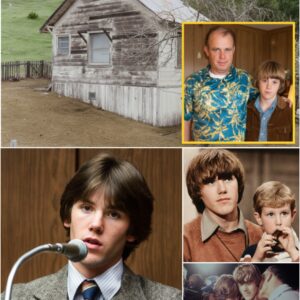
It is 11:47 p.m. on September 23, 1994.
The parking lot outside a small café in Gaylord, Michigan is nearly empty. A cold northern wind cuts through the dark, carrying the smell of pine and the faint sweetness of decaying leaves. Autumn has arrived fast this year. The kind of autumn that reminds you how quickly warmth can disappear.
Kathey Horn is standing next to a beat-up green van.
She is 16 years old. She is wearing a Red Hot Chili Peppers t-shirt, jeans, and a necklace she never takes off. She has places to be — a concert to catch, a group of friends waiting for her at sunrise, a future she is already planning in enormous, beautiful detail. She just needs a ride home.
The van door swings open.
A man named David Paul Czinki says, “Get in.”
What happens next will take eight years, two mushroom hunters, one grieving mother who refuses to stop fighting, and a witness who almost didn’t come forward — to finally bring to justice.
This is the story of Kathey Lynn Horn. And it deserves to be told in full.
The Girl They Called Jibber

If you were a teenager in Traverse City, Michigan in the early 1990s, you knew Kathey Horn. Even if you hadn’t met her yet, you would have recognized her the moment you did — the girl who talked so fast, so much, and with such genuine enthusiasm about everything that her friends eventually gave her a nickname that stuck for life.
Jibber.
Because she jibber-jabbered. Non-stop. About dolphins. About whales. About the ocean and what it felt like to be underwater with creatures that were smarter than most people gave them credit for. About how she was going to become a marine biologist one day and spend her life in the water, saving animals that couldn’t save themselves.
Kathey Lynn Horn was born on April 30, 1978, in Mount Clemens, a small city in Macomb County, Michigan. Her parents separated when she was still very young, leaving her mother, Janice Rott, to raise her alone. Janice was the kind of woman who didn’t complain about the hand she was dealt — she just figured out how to play it. When Kathey was about 13, in 1991, Janice decided they needed a fresh start. She loaded up their belongings and moved them north to Traverse City.
It was, by any measure, the right call.
Traverse City sits along the western shore of the Grand Traverse Bay in the northern Lower Peninsula of Michigan. It is the kind of place that photographs itself — cherry orchards rolling down to cold blue water, forests of maple and birch that turn electric in October, a downtown of independent shops and local restaurants that feels alive in a way that most small American cities have lost. People who live there tend to stay. People who visit tend to wish they had.
Janice found an apartment above a muffin shop — literally above a bakery — and carved out a life for herself and her daughter in a new town. Every morning Kathey woke up to the smell of fresh muffins rising through the floorboards. She went to school on streets lined with gold and red leaves. She made friends with the kind of easy warmth that some people spend a lifetime trying to manufacture.
Her friend Autumn Kelley would later describe Kathey with a simplicity that says everything: “She was always really happy, always shining. She would have had an awesome life. She wanted to be free. She wanted to be in the ocean, swimming with the dolphins. She wanted to save the dolphins and whales.”
But Kathey wasn’t just a dreamer. She was a doer. She collected canned food and cartons of milk and mailed them to children in Ethiopia. When she passed homeless people on the streets of Traverse City, she would tug her mother’s sleeve and say, “Mom, we have to help them.” More than once, Janice came home to find a stray teenager eating at their kitchen table because Kathey had invited them in.
And yet — Kathey was also, undeniably, a teenager of 1994.
She liked Red Hot Chili Peppers and the Grateful Dead. She liked the feeling of a night that started after ten o’clock with no particular plan. She had gotten a tattoo that Janice didn’t love. She had experimented with marijuana, which made Janice worry even more. She had lived with a boyfriend for a few months — a 20-year-old named Eric when she was 16 — until that arrangement quietly dissolved, as these things do at that age.
She was, in other words, figuring herself out. The way all teenagers do.
There was one more thing about Kathey that would later become the single biggest distraction in the investigation of her disappearance. She had, somewhere in the previous year or two, joined a coven — a small group of people who practiced Wicca and pagan earth worship in the forests around Traverse City. They wore robes. They drank consecrated wine. They lit candles in the dark and chanted to the moon and thanked the earth for its abundance. The group was led by a quiet man named Tim Coppett.
None of that had anything to do with what happened to Kathey Horn.
But in 1994, in a small Michigan town, the word “coven” was enough to make a detective forget everything else he was supposed to be looking at.
A Weekend With Plans
The weekend of September 23rd, 1994 was supposed to be a great one for Kathey.
She had arranged to spend it with her best friend, Jen. Janice drove Kathey to school on the morning of the 23rd, a Friday, and waved her off at the school entrance. She had given permission for Kathey to spend the weekend with Jen. A mother’s ordinary act of trust. The kind of thing you do a hundred times and never think twice about.
But the weekend’s real highlight — the thing Kathey had been thinking about for days — was what was planned for early Saturday morning.
The Rainbow Tribe was rolling through northern Michigan.
The Rainbow Family of Living Light, as they were formally known, was a loosely organized collective of hippies, free-spirits, and counterculture travelers who followed the concert circuit and gathered in forests and open fields to share food, music, and community. They were harmless, joyful, and completely unpredictable in their movements. And they were going to a Grateful Dead concert.
Kathey had made arrangements to meet them at 7 a.m. on Saturday, September 24th. She would hop in with the group, catch the concert, and be back before anyone missed her. She had told friends about it. She had planned what to bring. She had gone to sleep the night before excited in the specific way that only a teenager can be — the way that makes sleep itself feel like an obstacle.
That Saturday morning meeting would never happen.
The Last Night
After school on that Friday, Kathey and Jen drove to Gaylord — a small town about 50 miles southeast of Traverse City — to pick up three more friends. It was the kind of aimless, cheerful driving that teenagers do on Friday nights when they have nowhere important to be and all the time in the world.
They ended up at a local café — a gathering spot that the younger crowd around Gaylord and Traverse City had unofficially claimed as their own. Loud music, cheap coffee, the warm comfort of familiar faces in a cold night. Kathey was in her element. She was talking. She was laughing. She was Jibber.
And that is where she met David Paul Czinki.
David was 30 years old. He worked, or had worked, at this café — enough of a presence that the regulars knew his name and his face. He was the kind of man who existed at the edges of a social scene without ever quite being part of it. Always there. Never quite belonging. The kind of person teenagers accept a ride from because he’s familiar in the vague way that familiarity can sometimes be mistaken for trustworthiness.
Jen, meanwhile, had spotted someone she was interested in. She made a decision — the kind that teenagers make without thinking through the consequences — and told Kathey she was staying. “Dave will drive you and the others home,” she said. Or words to that effect.
Just like that, Jen was gone.
Kathey wasn’t worried. She was with three other people: a girl named Carrie, Carrie’s boyfriend Tyler, and their friend Jim. Five people total in David’s old green van, rolling through the dark Michigan countryside with the windows cracked and a shared joint making its way around the circle.
The drive from Gaylord toward Traverse City takes you through small towns connected by two-lane roads that cut through dense forests. It is beautiful country in daylight. At midnight, it is something else — long stretches of nothing, the occasional glow of a distant farmhouse, stands of trees that press close on both sides like walls.
David pulled into Mancelona, a small town roughly halfway between Gaylord and Traverse City, and stopped at a party store parking lot. He told Carrie, Tyler, and Jim this was their stop.
They got out.
The van door closed.
And now it was just Kathey and David.
She needed to get home. She told him so. Traverse City was still about 25 miles north. She needed to be up by 6:30 to meet the Rainbow Tribe. She needed to sleep. She needed to get there.
According to David — the only version of events that would ever exist from inside that van — Kathey asked to be let out about 100 yards up the road. Said she wanted to go back and join the party. Said goodnight. Got out. Walked away.
He watched her go.
He drove home.
That, David Paul Czinki would maintain for years, was the last he saw of her.
The holes in that story would not become fully visible until nearly a decade later. But the first hint was there that very night, the moment David stepped back into his apartment — knuckles sliced open and bleeding, hands shaking, asking his roommate to wash every piece of his clothing and scrub down the inside of his van.
The Monday Morning That Changed Everything
Monday morning, September 26, 1994.
Janice Rott is in her apartment above the muffin shop when she hears knocking.
She opens the door. It’s Jen.
Jen’s face is wrong. She asks, “Is Kathey here?”
And Janice says, “I thought she was with you.”
There is a beat of silence — the kind of silence that lasts only two seconds but changes the shape of everything after it.
They both start making calls. Janice tries Eric. She tries the school friends. She calls around to everyone who might have seen Kathey over the weekend. No one has. She calls the Rainbow Tribe contact. The person on the other end says something that lands in Janice’s chest like a stone: “We waited for her at seven o’clock Saturday morning. She never came.”
Kathey didn’t miss that concert because she overslept. Kathey didn’t miss it because she changed her mind. Kathey didn’t miss it because she was somewhere else having fun and forgetting to check in.
Kathey missed it because she never made it out of that van.
Janice went to the police. She was calm and clear and specific: her daughter was missing, she was not a runaway, she did not take extra clothes or money or personal items, she had concrete plans for Saturday morning that she had been excited about, and she would have called — at minimum, she would have called — if she had chosen to go anywhere voluntarily.
The police wrote it down. They listed Kathey Horn as a runaway.
Janice walked out of that police station and made a decision that would define the next eight years of her life. She was going to find her daughter herself.
One Woman Against Silence
Janice Rott quit her job the next day.
Not temporarily. Not “on leave.” She walked away from her income, her stability, everything she had built since moving to Traverse City, and she devoted herself entirely and completely to the search for Kathey.
She printed posters — hundreds of them, then thousands — and plastered them on every telephone pole, every gas station window, every coffee shop bulletin board from Traverse City to Gaylord to Mancelona and back. She organized candlelight vigils and invited the community to stand in the dark together, holding flames, refusing to let the case become invisible.
She used donated money — $580 scraped together by friends and neighbors — to hire a professional search consultant from Texas, a man who had spent his career finding people that local authorities had stopped looking for.
She installed a toll-free hotline in her apartment. She answered it herself. She built an entire nonprofit organization — the Missing Children’s Network of Michigan — out of nothing, out of grief, out of the simple refusal to accept that the system would move without her pushing it.
Janice Rott was not a law enforcement officer. She had no investigative training. She was a waitress who had moved to a tourist town with her daughter and built a quiet life above a muffin shop.
And she was the most effective person working this case for most of the years it remained open.
What the Detective Found — and What He Missed
The first detective assigned to the case, Detective Hill, at least had the presence of mind to notice something important early on. He pulled Kathey’s banking records. Her account had not been touched since before September 23rd. Not a dollar.
Teenagers who run away drain their accounts first. They take the cash they’ve been saving, they stuff it in a backpack, and they go. Kathey’s money sat untouched, as though it was waiting for someone who would never come back for it.
Hill handed the case to Detective Kevin Day.
Day pulled Jen in for a full interview. He talked to Kathey’s school friends. He tracked down Eric, the ex-boyfriend, who came in cooperating fully and grieving visibly. Eric had an airtight alibi — he was in Grand Rapids with friends all weekend, and multiple people confirmed it.
But Eric mentioned something that pulled the investigation sideways.
He told Detective Day that Kathey had been part of a coven. That she and Eric had attended rituals in the forest with a man named Tim Coppett. That they had worn robes, drunk consecrated wine, and chanted under the trees at night.
Day latched onto this like a hound on a scent.
When he arrived at Tim Coppett’s home, the first thing he saw was a pentagram painted on the front door. Inside: ravens, black candles, occult imagery, altar cloths, ceremonial objects that looked nothing like anything in Day’s experience.
He thought he had his answer.
Tim Coppett sat down with the detective and explained, patiently, that he ran a Wiccan coven — a nature-based spiritual practice that involved no violence, no dark rituals, and certainly no harming of young girls. White magic, he said. Light and gratitude and the turning of seasons. He submitted to a polygraph. He passed.
None of it mattered to Day’s instincts. He kept circling back to Tim, kept probing the coven angle, kept looking for a satanic conspiracy where there was none.
All the while, David Czinki was going about his days.
Day did eventually speak to David. He drove to Gaylord, sat across from him, and listened to the story about Kathey asking to be let out 100 yards up the road. He noticed the cuts on David’s knuckles — deep, jagged lacerations across the fingers, the exact kind of wounds that appear when someone is scratching and clawing in desperation.
David said he’d cut his hand on a broken van mirror.
And he was literally working on the van when the detective arrived, the mirror visibly damaged.
Day looked at the inside of the van. It was a catastrophic mess — trash everywhere, old food wrappers, tools, debris — but no obvious blood. He accepted David’s offer to allow an informal inspection. He did not formally administer a polygraph. He did not bring David into the station. He asked if David would take a lie detector test if asked.
David said sure, of course, no problem.
Day made a note and moved on.
Here is what Day did not know, or did not pursue: that same evening, David had come home to his roommate in a state of visible distress. His hands were wrapped. He was shaking. He was agitated in a way she had never seen from him before. He asked her — not gently, but with a pressure she found unsettling — to wash all of his clothes and to clean the inside of the van. This from a man who was, by all accounts, one of the messiest people anyone who knew him had ever encountered.
She did it. She thought it was strange. But she did it.
That testimony would sit dormant for years, waiting for someone to come and find it.
Three Suspects Who Weren’t
Detective Day had the names of the three other passengers who had ridden in the van that night: Carrie, Tyler, and Jim. Police in Mancelona helped track them down.
Carrie and Tyler were a couple. They had been friends with Kathey through the café circuit, nothing deeper. They told the same story, independently, with no contradictions. They took polygraphs. They passed.
Tyler had a shadow over him from the start — three years earlier, at 16, he had pleaded guilty to negligent homicide in connection with an accident. That made the detectives focus on him harder than the others. They ran him through every test they had.
He passed them all.
Jim, the last of the three, told the same story — and added the detail about the Grateful Dead concert and the Rainbow Tribe, which gave investigators a new direction to explore. They tracked down the itinerant group as best they could, made contact with members, and received the same answer: Kathey Horn never arrived.
One anonymous tip pointed to a young man named Sean Bart — someone allegedly bragging about raping and killing a girl. Detectives brought him in. He was utterly confused. It quickly became apparent that someone had called in the tip out of spite, following a snowmobile dispute. Polygraph administered. Sean cleared.
With each dead end, the case grew colder.
The coven angle produced nothing. The ex-boyfriend was clean. The passengers were clean. The anonymous tip was fake. And David Czinki — the last person to be alone with Kathey — was allowed to drift back into his ordinary life.
Then came March 1995.
Six months after Kathey’s disappearance, police pulled David Czinki over on an unrelated drunk driving charge. During the routine stop, David volunteered something that no one had asked him about.
He said he was probably going to prison for the Kathey Horn case.
Nobody had said her name. Nobody had brought up the investigation. It had nothing to do with the reason for the stop.
David Paul Czinki brought it up himself.
The officer wrote it down. Nobody acted on it. The case continued to go cold.
What the Forest Kept
Two years passed.
May 8, 1996. Northern Michigan mushroom hunters know that the woods in May are full of morels — those strange, spongy fungi that grow in the damp soil beneath dying elm trees and are prized enough that serious hunters guard their locations like secrets. Two men were out in the forest near Traverse City on that particular morning, following their usual routes along Pike School Road.
They found a pile of clothing.
Not clothing someone had carelessly tossed from a car window. Clothing that had been deliberately, methodically destroyed — shredded into pieces, torn apart with what must have been considerable force and considerable purpose. Among the fragments: a Red Hot Chili Peppers t-shirt. A pair of jeans. A necklace.
These were the clothes Kathey Horn had been wearing the last time anyone saw her alive.
Police roped off the area and searched. They found nothing else that day. No body. No additional evidence. Just the ruins of a teenager’s outfit, left in the woods two years after she had disappeared.
Ten days later, May 18, 1996, a different mushroom hunter was moving deeper into the same stretch of forest when he spotted what looked like an unusually large mushroom pushing up through the soil. He was excited. He walked toward it. He crouched down.
He was looking at the back of a human skull.
He stood up slowly and looked around. There was a femur. A fragment of rib. More bones, scattered across a small area, partially obscured by decomposed leaves and undergrowth. Covering the remains, or what was left of covering them, was a blanket — old and dirty and barely recognizable as fabric anymore.
Police were called. Evidence was collected with the grim patience of people who already suspected what they were going to find.
Dental records confirmed it within days.
Kathey Lynn Horn, 16 years old, had been lying in this forest for almost two years. The decomposition was too advanced to establish a cause of death. But the manner of death was not in doubt.
Homicide.
Someone had killed Kathey Horn and buried her here, in this stretch of woods along Pike School Road — the same stretch of woods where David Czinki regularly drove his van to illegally dump trash. His coworkers knew it. His drinking buddies knew it. It was one of those open secrets that exist around certain people — the things that feel mildly wrong in isolation but devastating in retrospect.
Janice received the news and sat down. She had spent two years operating on the assumption that her daughter was dead. She had willed herself to believe she was prepared for confirmation.
She was not prepared.
“I always figured I knew the answer,” she said later. “And when I heard it, I thought I’d feel better. But I didn’t. It is just an answer.”
Just an answer.
Two words that contain an ocean of grief.
The Moment Detectives Showed Him the Clothes
In the days after the clothing was discovered, police brought David Czinki back to the scene.
They showed him the pile of shredded fabric. They asked, carefully and deliberately, if he knew why Kathey Horn’s clothes might be in these woods.
David looked at the clothes. He looked at the detectives. And then he said something that his attorney would not be able to explain away at trial.
He said they had all the evidence they needed.
Then he asked for a lawyer.
1999: The Man Who Had Been Thinking for Five Years
After Kathey’s remains were found and identified, the case went quiet again. The cause of death could not be established. The circumstantial evidence was suggestive but not overwhelming. Prosecutors needed more.
In 1999, a local newspaper ran an anniversary piece on the case — a reminder that Kathey Horn existed, that her killer had never been charged, that her mother was still out there fighting. It was the kind of community journalism that rarely changes anything.
This time, it did.
A man named David Lowshaw read the article, and something clicked.
He had been living with this memory for five years, unsure whether it meant anything, telling himself it probably didn’t, talking himself out of the discomfort. But the article and the photograph of Kathey’s face brought it all back with sudden, undeniable clarity.
In the fall of 1994, Lowshaw and his wife had been doing what people in northern Michigan love to do in October — driving the back roads to look at the leaves changing color. The forests around Traverse City are extraordinary in autumn. The maples go from gold to orange to red in waves that move through the canopy like slow fire. It’s worth driving out for. People do it every year.
They were near the intersection of Berrywine Road and Pike School Road when they saw the van.
It was green. Old. Parked off the side of the road in a way that felt slightly wrong but not immediately alarming.
There was a man standing beside the van with a shovel, digging.
There was a girl on the other side of the van, propped up against the vehicle. She was not moving. Her skin was gray.
Lowshaw and his wife looked at each other. The scene was strange, but it was autumn, it was daylight, and there were any number of innocent explanations. Maybe the girl was sick. Maybe the man was burying a pet. Maybe it was something they had no business interfering with.
They drove on.
For five years, that image had lived in the back of David Lowshaw’s mind. And now, staring at the photograph of Kathey Horn in the newspaper, he understood what he had seen.
He called the police.
When investigators asked him to describe the man with the shovel, his description — height, build, approximate age — matched David Paul Czinki exactly.
All Roads Lead to One Green Van
Now the pieces were moving.
Detectives went looking for David Czinki and found him exactly where they might have expected: already behind bars, serving time on an unrelated theft conviction. He was brought back in for questioning about Kathey Horn.
This time, his composure was different. He still maintained his original story — she asked to be let out, she walked back toward the party — but his body language was telling a different story. He was fidgety in ways he hadn’t been before. The confidence that had served him through the early interrogations was fraying at the edges.
And now the investigators had testimonies they hadn’t had before.
Lowshaw’s eyewitness account placed David at the burial site, physically digging, with an incapacitated girl beside the van.
David’s roommate — the woman who had cleaned his clothes and scrubbed his van on the morning of September 24th — came forward and told police everything she had noticed that night. The state of his hands. The shaking. The unusual urgency about cleaning a van that was normally a rolling disaster zone. She had thought it was strange then. She understood it now.
Coworkers at the café confirmed two things that fit together in a way that was hard to dismiss. First: David had talked openly about being attracted to a 16-year-old girl from Traverse City. Not once, not in a passing comment — repeatedly, as though he couldn’t stop thinking about her. Second: David regularly drove out to the woods along Pike School Road to dump his trash illegally, which his coworkers knew about because he had mentioned it casually, as people sometimes do when they think of themselves as smart.
Those same woods. The same exact stretch of road.
And there was the statement he had made during the drunk driving stop in March 1995: “I’m going to prison for the Kathey Horn case.” Unprompted. Offered voluntarily by a man who, by his own account, had done nothing wrong.
And finally, there was the notebook.
When investigators went through David Czinki’s belongings, they found a notebook that didn’t belong to him — an unclaimed book with pages of handwriting that contained, according to the prosecution, language that was directly incriminating. The exact contents were detailed in court testimony but were not fully reported in the press. What is known is that the prosecution considered it significant enough to present to the jury.
Janice Rott had, by this point, hired a private investigator named David Ufer — who was also serving as the president of her Missing Children’s Network — to help her gather evidence and bring it to police. She had been doing this work herself for years: interviewing witnesses, documenting timelines, connecting dots that police had let scatter. Together, she and Ufer assembled a package of information that, combined with the Lowshaw testimony and the roommate’s account, finally gave prosecutors what they needed.
The Trial
David Paul Czinki went on trial for the second-degree murder of Kathey Lynn Horn in 2002.
Eight years after her death. Nearly eight years after Janice had walked into a police station and been told her daughter was a runaway.
The prosecution entered the courtroom with eyes open about what they were working with. Their lead attorney told the jury at the outset: most of this evidence is circumstantial. There is no DNA. There is no weapon. There is no confession. There is no witness who watched the act itself take place.
What they had instead was this:
A witness who watched a man who looked exactly like David Czinki digging a grave beside a green van, with a girl’s lifeless body propped against the side of it.
A woman who had cleaned blood and evidence from a van and a set of clothing at the specific request of the defendant, on the specific morning following Kathey’s disappearance.
A man who had repeatedly told coworkers he was obsessed with a 16-year-old girl from Traverse City.
A man whose pattern of illegal dumping placed him regularly in the exact section of forest where Kathey’s remains were found.
A man who voluntarily told a police officer, during a completely unrelated traffic stop, that he expected to go to prison for Kathey Horn’s case.
A man who, when shown the dead girl’s shredded clothing in the woods, did not ask a single question — did not say “what is this,” did not say “that’s terrible,” did not say “I don’t understand” — but instead announced that the police had all the evidence they needed and then asked for a lawyer.
And a notebook with handwriting that the prosecution argued spoke for itself.
The defense argued that every one of these pieces could be explained away, misinterpreted, or misattributed. That circumstantial evidence is not the same as proof. That a man can know things without being responsible for them. That David Czinki was an imperfect, messy, troubled individual but not a killer.
The jury listened for days. They reviewed the exhibits. They filed back into the courtroom with their verdict.
Guilty of second-degree murder.
The Sentence
Michigan’s sentencing guidelines for second-degree murder are substantial. But the number that matters here isn’t just the charge — it’s the history.
David Paul Czinki was, at the time of sentencing, a fourth-offense habitual offender. Four separate prior convictions. A record that stretched back years and touched multiple states and multiple crimes. Under Michigan law, the habitual offender enhancement allows for significantly enhanced sentences, and the judge applied the maximum.
Thirty-five to fifty-two and a half years.
David Czinki was taken from the courtroom and transported to the Lakeland Correctional Facility in Coldwater, Michigan, where he has remained ever since.
According to official Michigan Department of Corrections records, his earliest possible release date is February 2036. His maximum discharge date — the date by which he must be released even if he has not been paroled — is November 2043.
He will be well into his seventies before he leaves that facility, if he leaves at all.
And for Janice Rott — the woman who quit her waitress job and built a nonprofit organization and spent nearly a decade of her life demanding justice for her daughter — the verdict was not the triumph that justice is supposed to feel like.
It was, as she had said before about learning of Kathey’s death, just an answer.
The Weight That Never Lifted
There is a particular kind of grief that belongs to families whose loved ones were taken before anyone took the case seriously.
Janice Rott carried that grief in layers.
The grief of losing Kathey, obviously. The grief of the two years of not knowing — of wondering every single day whether her daughter was alive somewhere, suffering, waiting for rescue that wasn’t coming. The grief of being told, at the very beginning, that her daughter was just a runaway, a troubled kid who had chosen to disappear, when every bone in Janice’s body knew that wasn’t true.
And somewhere underneath all of that — the quiet, corrosive grief of knowing that David Czinki had been sitting right in front of Detective Day in 1994, with lacerated knuckles and a barely plausible story, and had been allowed to walk away.
If Day had pushed harder. If he hadn’t been so distracted by the pentagram on Tim Coppett’s door. If he had formally administered the polygraph that David himself had offered to take. If he had taken that roommate’s story seriously. If he had cross-referenced David’s trash-dumping habits with the location of the missing girl’s disappearance route.
If, if, if.
Kathey Horn’s remains might have been found in 1994, not 1996. David Czinki might have been arrested in 1994, not charged in 2001, not convicted in 2002. And Janice Rott might have spent a few years less of her life fighting alone in a small apartment over a muffin shop, answering a toll-free hotline that the police should have been running.
None of that can be undone.
What can be said is this: Janice Rott found justice for her daughter in circumstances that were designed to prevent her from doing so. She worked without institutional support, without pay, without recognition, and without giving up. The Missing Children’s Network of Michigan that she founded out of desperation in 1994 became a real organization that helped real families in circumstances just like hers. She turned her worst nightmare into a mechanism for preventing other families from experiencing the same silence she had faced.
That is not a consolation. But it is something.
What the Coven Never Was
It is worth taking a moment — because this case demands it — to address what sent the investigation sideways for so long.
Tim Coppett and his coven were not responsible for Kathey Horn’s death. They were not dangerous. They were not practicing anything harmful. They were a small group of adults who practiced a nature-based spiritual tradition, held private ceremonies in the woods, and wanted to be left alone.
The reason Detective Day spent so much time investigating them is the same reason this kind of misdirection happens in cases involving unfamiliar subcultures: difference is easy to mistake for danger. A pentagram on a door is not evidence of murder. Robes and consecrated wine are not criminal. Chanting under the moon is not the same as burying a girl in a blanket.
David Czinki was not part of the coven. He was not a member of any occult group. He was, as best as anyone has been able to determine, a 30-year-old man with a serious criminal history, a deeply troubled relationship with women, and a fixation on a 16-year-old girl that he had no right to have.
He picked her up in his van. He drove her friends out of the vehicle one by one until only she remained. And then he did what he did, in the dark, on a road in northern Michigan, while Kathey Horn’s mother was asleep above a muffin shop, dreaming of whatever mothers dream of when their children are out for the night and everything still feels safe.
The occult angle cost this investigation critical time. The right man was identified within days and then set aside for years while everyone chased shadows in the forest.
Sometimes the monster doesn’t have a pentagram on his door.
Sometimes he just has a van.
What Happened to David Paul Czinki
As of the most recent available records, David Paul Czinki remains incarcerated at the Lakeland Correctional Facility in Coldwater, Michigan. He was born in approximately 1964, which makes him around 61 or 62 years old today. He has been behind bars since his conviction, with no successful appeals noted in public records.
His earliest release date — February 2036 — is still a decade away from the time of this writing. He will be in his mid-seventies if he ever walks out.
He has never, in any public record, admitted responsibility for Kathey Horn’s death. He has never apologized to Janice Rott. He has never explained what happened in that van, on that road, in the dark, on the night of September 23rd, 1994.
There is a notebook somewhere in the evidence chain with words in his handwriting that the jury found incriminating. Whatever those words say, they have not been made fully public. They may never be.
The cause of Kathey’s death remains, officially, undetermined — her remains were too far gone by the time they were found. Whether she was strangled, stabbed, struck, or killed by some other means, no one outside of David Czinki knows for certain.
He is the only person alive who knows exactly what Kathey Horn’s last moments were like. What she said. What she did. Whether she fought back — and those lacerated knuckles suggest that she did, with everything she had.
He takes that knowledge with him every morning when he wakes up in a Michigan correctional facility, and he has kept it for thirty years.
Kathey Lynn Horn
She would be 47 years old this year.
Old enough to have gone to college, become a marine biologist, spent her career in the water with the creatures she loved. Old enough to have watched the ocean warm and change and to have dedicated herself to understanding what that meant. Old enough to have laughed, gotten older, maybe had children of her own who would have inherited her non-stop talking and her enormous heart.
Old enough to have called her mother on a Sunday morning just to check in.
None of that happened.
What happened instead was a Friday night, a coffee shop, a green van, and a man who had no right to any of the decisions he made.
Kathey Horn was not a cautionary tale about the dangers of hitchhiking, or the dangers of joining a coven, or the dangers of being a rebellious teenager. She was a girl who needed a ride home. She was in the company of three other people when she got into that van. She had every reason to believe she would be fine.
She was not fine.
The forest held her for two years. Her mother fought for eight. The system that failed her in 1994 eventually caught up, slowly and imperfectly, in 2002.
And somewhere in the roots of the trees along Pike School Road — in the soil that kept her secret until two strangers came looking for mushrooms — something of Kathey Lynn Horn remains.
The girl who wanted to swim with dolphins.
The girl they called Jibber.
The girl who never came home.
The case of Kathey Lynn Horn was featured in the Investigation Discovery series Nightmare Next Door (Season 9, Episode 10: “Bewitching Hour”) and is revisited in Buried in the Backyard Season 6, Episode 12: “Hitchhike to Nowhere,” airing March 7, 2026, on Oxygen True Crime. If you have information about any unsolved crime, contact the National Center for Missing & Exploited Children at 1-800-THE-LOST.